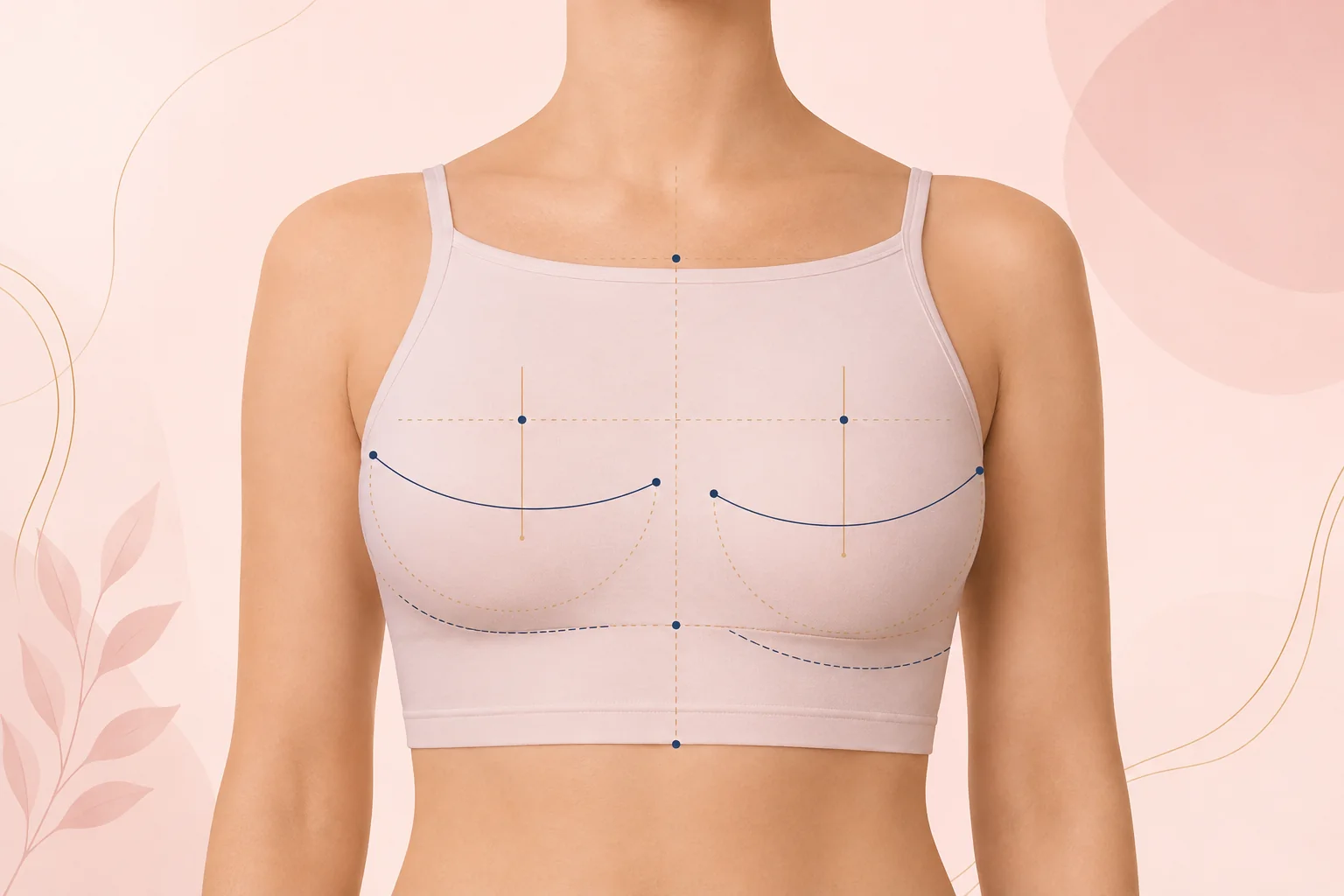
Breast asymmetry assessment in Klang
One Breast Bigger, Lower or Different in Shape?
You are not imagining it—and it is not always just a size
difference. Breast asymmetry may involve volume, nipple position,
skin, the breast fold or even the shape of the chest wall.
Ask Dr Agnes Privately
Common
A small, stable difference between the breasts is normal.
Not only size
Nipple height, droop, breast width and chest shape also matter.
Personalised
The right solution depends on what is actually causing the difference.
What Are You Noticing?
Most patients do not arrive using medical terms. They usually
describe one of these everyday problems.
01
“One breast is clearly smaller.”
This may be mainly a volume difference—but the smaller breast can
also have a narrower base, tighter skin or a different fold.
What may be discussed: an implant, fat grafting,
reduction of the larger side, or a combination.
02
“One nipple sits lower.”
Adding volume does not automatically lift a low nipple. The breast
skin and degree of droop need to be considered separately.
What may be discussed: a breast lift on one or
both sides, sometimes with augmentation.
03
“One breast feels heavier or droops more.”
The larger breast may have more tissue and a looser skin envelope,
especially after pregnancy, breastfeeding or weight change.
What may be discussed: reduction, lifting, or
balancing surgery on both breasts.
04
“The shape looks different—not just the size.”
The breast base, lower pole, breast fold, ribs or chest muscle may
differ. Some patients also have a constricted or tuberous breast shape.
What may be discussed: reshaping, fold adjustment,
implant selection, fat grafting or combined treatment.
The question I hear most
“Can’t you just put a bigger implant in the smaller breast?”
Sometimes different implant volumes can improve the balance—but an
implant mainly changes volume and projection. It cannot reliably
correct every difference in nipple height, breast-fold level, skin
looseness or chest-wall shape.
That is why two patients with a similar cup-size difference may
need completely different plans.
The useful question is not simply “Which implant size?” It is
“Which parts of the asymmetry can each treatment actually improve?”
So, What Are the Possible Solutions?
There is no single breast-asymmetry operation. The goal may be to
enlarge the smaller breast, reduce or lift the larger breast,
reshape both—or decide that no surgery is needed.
Add volume with an implant
May help: a noticeable volume or projection
difference. A one-sided implant or different implants on each
side may be considered in selected patients.
Limit: it does not directly lift a nipple or
correct every shape and chest-wall difference.
Add modest volume with fat grafting
May help: a smaller, localised volume or contour
difference without using an implant.
Limit: suitable donor fat is needed, some fat
may not persist, and staged treatment may be required.
Lift the lower breast
May help: a lower nipple, looser skin or unequal
droop. Limit: a lift leaves scars and does not
necessarily create more breast volume unless combined with
augmentation.
Reduce the larger breast
May help: when the preferred result is smaller,
lighter breasts or when one side is substantially larger.
Limit: reduction creates scars and may affect
nipple sensation and breastfeeding.
Combine different treatments
May help: complex differences involving both
size and shape—for example, augmentation on one side and lifting
or reduction on the other. Limit: each side can
still heal and change differently.
Has the difference appeared recently?
A long-standing developmental difference is not the same as a new
breast change. Please arrange a medical assessment if one breast has
changed recently—particularly with a new lump, persistent focal pain,
nipple discharge, nipple pulling inward, skin dimpling, redness or
ulceration.
Medical assessment and any necessary breast imaging come before
cosmetic planning.
What Happens During an Asymmetry Consultation?
The consultation is about understanding the whole shape—not judging
your breasts by a single measurement or bra cup.
STEP 01
You explain what bothers you
Which difference do you notice most? Would you prefer to be larger,
smaller, lifted—or simply better balanced?
STEP 02
Both breasts and the chest are assessed
Volume, width, nipple position, skin, droop, breast folds and
chest-wall differences are considered together.
STEP 03
The trade-offs are made clear
You should understand the likely improvement, scars, limitations,
recovery, risks and whether staged or revision surgery could be needed.
“
Better balance—not a perfect mirror image.
Natural breasts are not identical. Surgery aims for a meaningful
improvement that fits your anatomy, but residual differences can
remain. Healing, scars, pregnancy, ageing and weight changes can also
affect each breast differently over time.
Considering More Volume Too?
If your goal includes fuller breasts, asymmetry planning can be
incorporated into an augmentation consultation. Implant width,
projection, tissue coverage and existing differences should be
considered before choosing volume.
Read the detailed guide to
breast augmentation in Klang
,
including implants, fat grafting, recovery and implant-related risks.
Not Sure Which Operation You Need?
You do not need to diagnose yourself before booking a consultation.
“One side feels different” is enough to begin a proper assessment.
- Bring photos showing your preferred overall size or shape
- Mention pregnancy and breastfeeding plans
- Share any previous breast imaging or surgery history
- Ask which differences are realistically correctable
A note from
Dr Agnes
The plan should start with your priorities.
Some patients want the smaller breast enlarged. Others would rather
reduce the larger side or avoid implants completely. During
consultation at Bukit Tinggi Medical Centre in Klang, the discussion
begins with the change that matters most to you, followed by what
your anatomy can reasonably support.
Questions Patients Commonly Ask
Clear answers to the concerns people often have before an asymmetry
consultation.
Is it normal for one breast to be bigger than the other?
A small, stable difference between the breasts is common. A new or
progressive difference—particularly with a lump, skin change,
nipple discharge or nipple retraction—should be medically assessed.
Can I have an implant in only one breast?
A one-sided implant may be considered in selected patients when
the main difference is volume. Whether it can produce an acceptable
balance depends on breast width, skin, tissue thickness, nipple
position, breast fold and chest-wall anatomy.
Will different implant sizes make my breasts the same?
Different implant sizes may improve a volume difference, but cannot
correct every difference in breast shape, nipple height,
breast-fold level, droop or chest-wall structure. Perfect symmetry
cannot be guaranteed.
What if I do not want breast implants?
Depending on anatomy and goals, alternatives may include fat
grafting to the smaller breast, reduction of the larger breast, a
breast lift, a combined approach or no surgery. Fat grafting
generally provides a more modest and less predictable volume
increase than an implant.
Can breast asymmetry be corrected perfectly?
The aim is meaningful improvement rather than perfect mirror-image
symmetry. Natural anatomy, healing, scars, tissue stretch,
pregnancy, ageing and weight change can all affect the result.
Written and medically reviewed by Dr Agnes Yeo ·
Last reviewed 7 September 2026
Still Unsure What Is Causing the Difference?
Arrange a private consultation with Dr Agnes Yeo in Klang to discuss
what you notice, what may be improved and which options fit your
priorities.
Enquire on WhatsApp
Private and professional consultation